咨询与报价
ENThis project involved a rigid-flex and flexible printed circuit (FPC) designed for the signal interface module of an ultrasound probe used in modern medical devices. The board connected multiple ultrasound transducer channels to signal processing electronics within the compact probe assembly, combining rigid sections for signal conditioning with a flexible circuit that routed signals through the narrow probe structure.
During our engineering review prior to fabrication flex board production, the most critical issue was identified in the rigid-to-flex transition region.
In ultrasound probe assemblies, the flexible circuit must bend to fit within the probe housing during installation. In the original layout, several high-density signal traces crossed too close to the transition area between the rigid and flex sections. This region experiences the highest mechanical stress during assembly and operation of Flexible circuits.
If the routing remained unchanged, repeated mechanical stress in the transition area could eventually lead to copper fatigue and long-term reliability concerns. In addition, the stack-up did not fully compensate for dielectric differences between FR-4 rigid layers and polyimide Flexible PCBs, which could influence signal stability.
Copper spacing in the flex routing area was also approaching minimum process limits, leaving limited margin for stable printed circuit manufacturing.
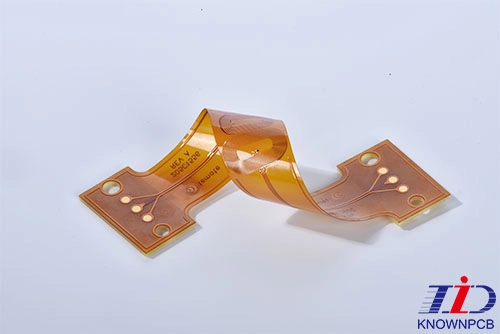
During DFM review and the flex PCB prototyping phase, our engineering team optimized the routing and stack-up during the flex PCB prototyping phase to address the transition reliability risk while preserving the original electrical design.
Critical signal traces were rerouted away from the dynamic bend zone near the rigid-flex interface, reducing mechanical stress on the copper conductors. The stack-up was refined by adjusting dielectric thickness between rigid and flexible layers to maintain consistent electrical performance.
Additional spacing optimization was applied in the flex routing area to improve production tolerance. During manufacturing, controlled lamination and inspection processes were implemented to ensure consistent quality in multilayer circuit boards and flexible circuits used in medical application environments.
Production followed an ISO 9001 quality management system, with build requirements aligned with IPC-6013 Class 3 reliability expectations commonly applied to high-reliability flexible circuit products.reliability standards for flexible circuit products.
These improvements were verified through flexible PCB prototype evaluation before entering full production.
After the refinements, the rigid-flex PCB transitioned smoothly from prototype validation into volume production.
The boards underwent electrical validation, including flying probe testing and controlled impedance verification, confirming stable signal performance.
Because flexible circuits eliminate the need for printed circuit board assembly (PCBA) in specific interconnect zones, the final design also simplifies the assembly process. This reduction in circuit board size and weight makes this approach highly advantageous for ultrasound probe designs.
KnownPCB specializes in the manufacturing of flexible and rigid-flex printed circuit boards (PCBs) that meet the demands of the medical industry, providing companies developing medical devices, flexible circuits, or rigid-flex PCBs with a reliable supply of circuit boards that deliver consistent production performance and long-term reliability.